
|
Getting your Trinity Audio player ready...
|
Competition can divide a market. Great rivalry can define a culture.
There was a time when cola was simply a carbonated drink.
Then Coca-Cola and Pepsi turned it into something else.
A preference.
A personality.
A declaration of taste.
At times, almost a side to be chosen.
For generations, consumers have been asked a deceptively simple question:
Coke or Pepsi?
Behind those two words lies one of the most enduring rivalries in business.
The two companies competed through product, price, distribution and advertising. But the rivalry eventually moved beyond the bottle. It entered music, sport, celebrity, youth culture, restaurants, entertainment and everyday conversation.
And something remarkable happened.
The competitors did not merely fight over the cola market.
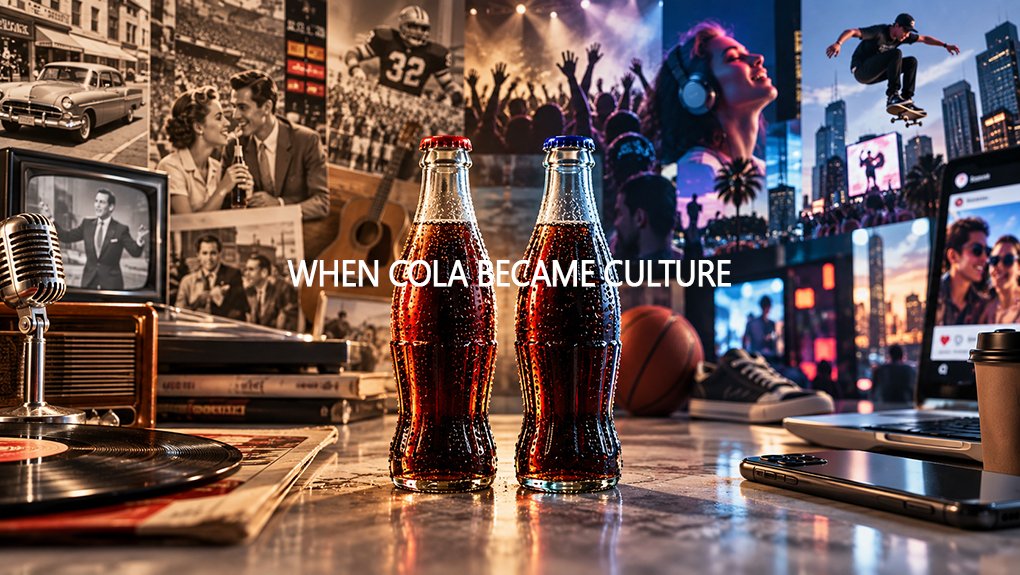
They helped make the cola market culturally important.
That is what makes Coca-Cola versus Pepsi such a fascinating lesson in competitive strategy.
When a Product Becomes an Identity
Products usually begin by solving a functional need.
A drink refreshes.
A shoe protects the foot.
A car provides transportation.
Powerful brands gradually acquire another function: they help people express something about themselves.
Coca-Cola and Pepsi became masters of this transition.
Coca-Cola built enormous equity around familiarity, continuity and emotional connection. Its advertising repeatedly associated the brand with shared experiences, optimism and togetherness. The company’s own historical account describes how its emotional bond with consumers became increasingly powerful and global during the twentieth century. (Coca-Cola Company)
Pepsi developed a different competitive personality.
Rather than attempting simply to become another Coca-Cola, it increasingly embraced the role of the challenger: younger, energetic and willing to question convention. PepsiCo itself continues to describe a “challenger mindset” as part of the brand’s identity. (PepsiCo)
That distinction mattered.
When competing brands occupy different psychological territories, consumers are no longer choosing only between products.
They are choosing between meanings.
And meanings are much harder to copy than ingredients.
The Challenger Changes the Question
A market leader naturally benefits when consumers accept the existing rules of the category.
A challenger has another option:
Change the question.
The Pepsi Challenge became one of the clearest demonstrations of that principle.
Instead of asking consumers which cola had the greatest history, distribution or cultural familiarity, Pepsi invited them to participate in blind taste tests.
The label disappeared.
The heritage disappeared.
The advertising disappeared.
For those few seconds, the competition was reduced to taste.
The original Pepsi Challenge dates back roughly half a century, and Pepsi has repeatedly revived the concept since then. (PepsiCo)
Strategically, its significance goes beyond who preferred which drink in any particular test.
Pepsi had found a way to frame the contest on territory favourable to a challenger.
That is an important competitive lesson.
If you cannot easily defeat the leader under the existing rules, look for a different rule.
The best challengers do not merely compete harder.
Sometimes they redefine what consumers are being asked to compare.
Coca-Cola’s Greatest Strength Was Invisible
Taste tests, however, revealed only part of the story.
Consumers do not experience brands blindfolded.
They see the bottle.
They recognise the logo.
They remember childhood occasions, advertisements, restaurants, celebrations and people.
They bring decades of associations to a sip.
Coca-Cola discovered just how powerful those associations were in 1985.
Facing competitive pressure and declining preference measures in the United States, the company reformulated Coca-Cola. According to the company, the new formula had performed strongly in extensive taste testing involving nearly 200,000 consumers. (Coca-Cola Company)
Then came the surprise.
Consumers protested.
Some stockpiled the original product. Thousands contacted the company. After 79 days, Coca-Cola announced the return of the original formula as Coca-Cola classic. (Coca-Cola Company)
The episode became one of marketing’s most discussed case studies.
But beneath the familiar New Coke story lies something more interesting.
The research had measured how people responded to a liquid.
It had not fully measured how they responded to a relationship.
Coca-Cola itself later acknowledged that the testing had failed to capture the emotional attachment consumers had to the original product. (Coca-Cola Company)
That distinction is enormous.
A Brand Is More Than the Attributes We Can Measure
Businesses understandably like measurable things.
Price.
Taste.
Performance.
Features.
Awareness.
Market share.
But strong brands accumulate value that is difficult to isolate on a spreadsheet.
Memory.
Habit.
Ritual.
Nostalgia.
Trust.
Identity.
The New Coke episode demonstrated the danger of assuming that a product’s measurable attributes represent the entirety of the brand.
They do not.
A competitor can sometimes reproduce a feature.
It is considerably harder to reproduce decades of memory.
This is one reason established brands can remain powerful even when challengers produce compelling alternatives.
Their competitive advantage exists partly inside factories and distribution systems.
But part of it exists inside people’s heads.
Pepsi Found Another Weapon: Youth
If Coca-Cola possessed heritage, Pepsi could hardly manufacture an equally long heritage overnight.
So it turned the apparent disadvantage into strategic territory.
It looked forward.
Over decades, Pepsi repeatedly connected itself with youth, entertainment, music and popular culture. PepsiCo describes the brand’s history as including major relationships with musicians, sport and entertainment and credits it with pioneering forms of lifestyle marketing. (PepsiCo)
The underlying strategic logic was powerful.
Coca-Cola could represent something enduring.
Pepsi could represent something arriving.
One brand could draw strength from familiarity.
The other could draw strength from change.
This is where rivalry becomes productive.
Each competitor’s positioning puts pressure on the other to sharpen its own identity.
The leader cannot become complacent.
The challenger cannot afford to become indistinguishable.
Competition forces differentiation.
When Advertising Becomes Entertainment
The Cola Wars also helped push advertising beyond conventional product communication.
The question was no longer simply:
Why should someone buy our drink?
It increasingly became:
How do we become part of what people are already talking about?
Music provided one route.
Sport provided another.
Celebrity became another.
Television, major events and eventually digital culture expanded the battlefield further.
Pepsi’s association with popular entertainment became particularly visible, while Coca-Cola continued building large-scale emotional and cultural campaigns of its own.
The brands were no longer merely advertising within culture.
They were competing for a place inside culture.
That changed the scale of the rivalry.
A supermarket shelf has limited space.
Culture does not.
The Battlefield Kept Expanding
Perhaps the most revealing feature of Coca-Cola versus Pepsi is how many arenas their competition eventually touched.
Even space became one.
In 1985, Coca-Cola and Pepsi both developed experimental containers so their beverages could be tested aboard the Space Shuttle Challenger. The Smithsonian’s National Air and Space Museum describes the episode as part engineering experiment, part public-relations contest in the wider Cola Wars. (Smithsonian Magazine)
Think about what that says about rivalry.
Two companies selling carbonated beverages had reached a point where being consumed in orbit carried symbolic competitive value.
The practical importance of astronauts drinking cola was negligible.
The cultural importance of being associated with the moment was another matter entirely.
When rivalry becomes intense enough, competitors begin looking for battlegrounds that did not previously exist.
Rivalry Can Grow the Story Around a Category
Competition is often discussed as though one company’s gain must always be another company’s loss.
At the transaction level, that can be true.
A consumer ordering one cola may not order the other.
But rivalry can produce a broader effect.
It can make the entire category more visible.
Coke versus Pepsi gave journalists something to discuss.
Advertisers something to dramatise.
Consumers something to debate.
Restaurants something to specify.
Popular culture something to reference.
The rivalry created a continuing narrative.
And narratives attract attention.
This suggests a counterintuitive idea:
Your strongest competitor may sometimes help make your category more interesting.
The rival forces comparison.
Comparison encourages conversation.
Conversation keeps both brands mentally available.
Neither company created cola culture alone.
Their contest helped create it together.
The Leader Needs the Challenger Too
It is easy to view rivalry primarily from the challenger’s perspective.
The challenger has an obvious target.
But strong challengers also influence leaders.
They expose vulnerabilities.
They question assumptions.
They force reactions.
They prevent comfortable habits from becoming permanent.
Pepsi’s pressure helped ensure that Coca-Cola could never behave as though its historic position alone guaranteed the future.
Likewise, Coca-Cola’s enormous brand strength gave Pepsi something valuable: a clearly recognisable opponent against which the challenger could define itself.
This is one of the paradoxes of competitive strategy.
Rivals oppose each other, but they can also help define each other.
Without the leader, the challenger loses part of the contrast that makes challenging meaningful.
Without the challenger, the leader loses an important source of pressure.
Rivalry Makes Positioning Visible
Imagine Coca-Cola without Pepsi.
Or Pepsi without Coca-Cola.
Each would still be a major brand.
But something would disappear.
The contrast.
Rivalries make positioning easier to see because one strategy throws another into relief.
Heritage becomes more noticeable beside youth.
Continuity becomes more noticeable beside disruption.
Emotional familiarity becomes more noticeable beside challenge.
The competitive landscape becomes a mirror in which each brand’s identity becomes clearer.
This is why positioning should never be developed entirely in isolation.
A brand does not occupy a market alone.
Its meaning is partly determined by what competitors represent.
The Most Dangerous Move Is Becoming the Other Brand
Strong rivals learn from one another.
But imitation creates a trap.
If Pepsi abandoned its challenger personality merely to resemble Coca-Cola, it would surrender much of the reason for choosing Pepsi.
If Coca-Cola abandoned its accumulated emotional heritage merely to appear more like Pepsi, it would weaken an extraordinary asset.
Competitive intelligence therefore requires discipline.
Study the competitor.
Understand the competitor.
Respond when necessary.
But do not automatically become the competitor.
The objective of rivalry is not convergence.
It is sharper distinction.
What Coca-Cola vs Pepsi Teaches Us
The enduring Cola Wars offer lessons far beyond beverages.
First, categories can become cultural territories.
When brands attach themselves to identity, entertainment, memory and social behaviour, the competition becomes larger than product attributes.
Second, challengers can redefine the battlefield.
The Pepsi Challenge demonstrated the power of changing the basis on which consumers compare competitors.
Third, emotional equity is a real business asset.
New Coke showed dramatically that consumers may value what a brand represents as much as what the product objectively delivers.
Fourth, rivalry can strengthen differentiation.
Coca-Cola and Pepsi became more recognisable partly because each had a formidable opponent against which to define itself.
Fifth, competitors can enlarge the conversation around a category.
Decades of public competition kept cola visible not merely as a beverage, but as a cultural choice.
And perhaps the most important lesson:
The greatest rivalries are not only battles for customers. They are battles over meaning.
From Cola to Culture
Coca-Cola versus Pepsi has survived changes in media, generations, consumer preferences and marketing technology.
The battleground keeps evolving.
The fundamental contest remains recognisable.
One brand carries extraordinary historical and emotional equity.
The other has repeatedly found energy in challenging convention and inserting itself into contemporary culture.
Neither has succeeded simply by selling flavoured carbonated water.
They built symbols.
And through decades of competition, those symbols became larger.
That is the strange power of a great rivalry.
The competitors fight to take something from one another.
Yet in the process, they can create something neither could have built alone.
Coca-Cola and Pepsi competed for the cola market.
Together, they helped turn cola into culture.
— Jitendra Sheth, author of Clash of the Titans