
|
Getting your Trinity Audio player ready...
|
APPLE VS SAMSUNG: WHEN INNOVATION BECOMES COMPETITION
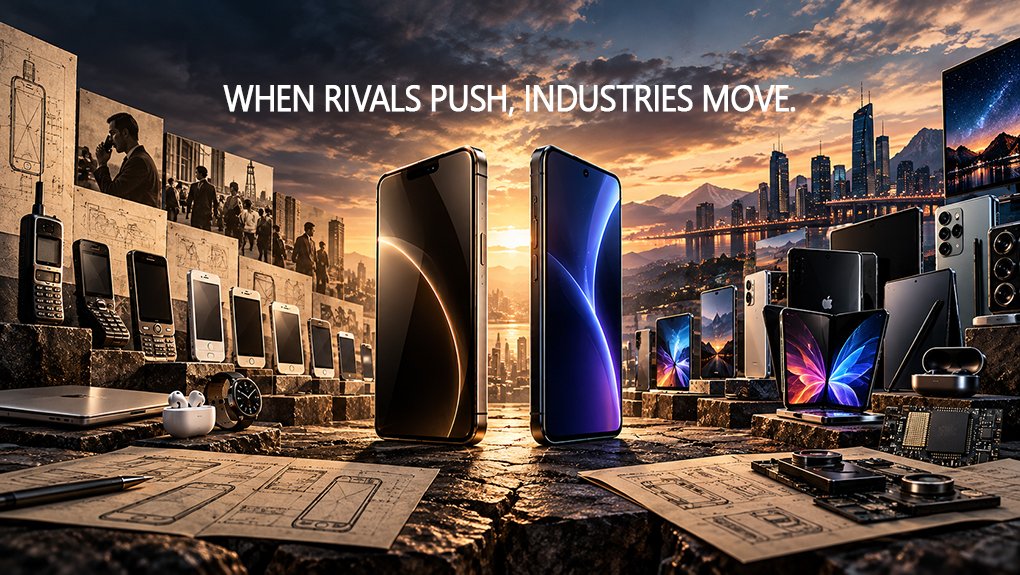
Two technology giants did not simply compete for smartphone buyers. They pushed each other to rethink what a smartphone could become.
Some rivalries divide markets.
Others redefine them.
Apple and Samsung belong to the second category.
For more than a decade, their competition has played out through product launches, design choices, cameras, displays, processors, software ecosystems, pricing, marketing and intellectual property.
Yet the most interesting part of the rivalry is not which company sold more phones in a particular year.
It is what happened because neither could afford to stand still.
Apple challenged the conventions of the mobile phone.
Samsung challenged the idea that there was only one way to build the smartphone of the future.
And somewhere between those two approaches, an entire industry accelerated.
WHEN THE PHONE STOPPED BEING JUST A PHONE
The arrival of the iPhone in 2007 changed expectations around mobile computing.
Apple brought together a large touchscreen, software, internet access, media and eventually an expanding application ecosystem in a product built around simplicity and integration.
The smartphone was no longer merely a better telephone.
It was becoming a computer people carried everywhere.
Samsung recognised the significance of that shift.
But rather than simply accepting Apple’s interpretation of the category, Samsung became one of the most aggressive competitors in the emerging Android market.
Its Galaxy smartphones expanded rapidly across screen sizes, specifications, price points and form factors.
Two different philosophies began taking shape.
Apple concentrated on a tightly controlled ecosystem in which hardware, software and services increasingly worked together.
Samsung pursued breadth, experimentation and speed across a much wider portfolio.
The rivalry was no longer simply about products.
It was becoming a competition between different ideas of innovation.
TWO DIFFERENT WAYS TO INNOVATE
Apple’s strength has traditionally come from integration.
The company controls much of the experience surrounding its products, from operating systems and processors to services and the broader device ecosystem.
The objective is not necessarily to introduce every technology first.
It is often to make technologies work together in a way that feels coherent to the user.
Samsung developed a different competitive rhythm.
Its enormous capabilities across electronics, semiconductors, displays and manufacturing allowed it to experiment aggressively.
Larger screens appeared.
New display technologies developed.
Multiple camera configurations expanded.
Foldable devices emerged.
Different product tiers allowed Samsung to compete across a far broader spectrum of the smartphone market.
Neither philosophy is inherently superior.
What matters is what happened when they confronted each other.
Apple’s discipline forced Samsung to think increasingly about experience, ecosystem and premium brand value.
Samsung’s speed and experimentation placed pressure on Apple to respond to changing expectations around displays, cameras, screen sizes and device capabilities.
Competition became a feedback loop.
THE COMPETITOR THAT CHANGES YOUR ROADMAP
This is where powerful rivalry becomes strategically interesting.
A weak competitor may take some customers.
A strong competitor can change your priorities.
When Samsung demonstrated consumer appetite for larger smartphone displays, the industry moved rapidly in that direction.
When Apple demonstrated the commercial power of a deeply integrated ecosystem, competitors increasingly understood that the battle extended beyond hardware specifications.
When one company improved photography, the other faced pressure to respond.
When one pushed display technology, processing power, privacy, artificial intelligence or device integration, expectations moved again.
The benchmark kept shifting.
That is one of the least appreciated consequences of serious competition.
Companies begin by competing against one another.
Eventually they compete against the expectations they have jointly created.
THEN THE RIVALRY MOVED INTO THE COURTROOM
Competition between Apple and Samsung eventually became about more than consumers.
It became a global legal battle.
Beginning in 2011, the companies fought major patent disputes across multiple jurisdictions involving smartphone design and technology. The litigation became one of the most visible intellectual property confrontations in the technology industry.
The arguments raised a much larger strategic question.
Where does inspiration end and imitation begin?
That question becomes especially difficult in fast moving categories.
Successful innovations quickly influence consumer expectations. Once customers become accustomed to certain interactions, shapes, gestures or features, competitors face pressure to offer comparable experiences.
But intellectual property exists precisely because innovation requires investment.
The Apple Samsung legal battles therefore exposed a tension at the heart of modern competition.
Companies need to learn from markets.
They also need to remain distinctive.
Competition encourages imitation and differentiation at the same time.
RIVALS IN THE MARKET. PARTNERS BEHIND THE PRODUCT.
There is another reason this rivalry is unusually fascinating.
Competition does not always mean separation.
Samsung has also participated in Apple’s supply chain.
Apple’s own current manufacturing information lists Samsung among companies working within its manufacturing programme, including semiconductor work connected with Apple products. Apple
Think about the strategic paradox.
Two companies can fight fiercely for the same consumer while simultaneously participating in the industrial network that makes those products possible.
That tells us something important about modern business.
Competitors are no longer always simply competitors.
They can be suppliers, partners, customers and rivals at the same time.
The relationship becomes an ecosystem rather than a straight line.
THE BATTLE MOVED BEYOND THE DEVICE
Over time, another transformation occurred.
The smartphone itself became only one part of the rivalry.
Apple expanded the strategic importance of the ecosystem around the iPhone through watches, computers, tablets, services, accessories and increasingly its own silicon.
Samsung developed its own interconnected universe spanning smartphones, tablets, watches, televisions, appliances, displays and other electronics.
The battlefield widened.
Winning a customer was no longer only about selling the best phone.
It increasingly meant creating reasons for that customer to remain within a broader ecosystem.
This changes the economics of competition.
A customer choosing between two smartphones may also be choosing between two networks of future products and services.
The first purchase becomes the entrance to a much larger commercial relationship.
COMPETITION CREATES ITS OWN MOMENTUM
One of the most revealing aspects of Apple versus Samsung is how difficult it becomes to separate innovation from competitive pressure.
Would smartphones have developed rapidly without intense rivalry?
Almost certainly.
Technology rarely advances because of one company alone.
But competition changes the speed and direction of that progress.
A competitor turns possibility into urgency.
Ideas sitting on development roadmaps suddenly become priorities.
Weaknesses that might once have been tolerated become vulnerabilities.
Features become expectations.
Experiments become categories.
The foldable smartphone is a useful example.
Samsung invested heavily in bringing foldable devices into the mainstream premium market.
Whether every consumer wants one is almost beside the point.
The experiment expands the boundaries of what competitors must consider possible.
That is what ambitious rivals do.
They do not merely compete within categories.
They stretch them.
THE SCOREBOARD KEEPS CHANGING
Market leadership between major smartphone manufacturers can shift from quarter to quarter.
For example, IDC data reported by Reuters showed Samsung regaining the top position in global smartphone shipments in the first quarter of 2024 after Apple had led at the end of 2023. Reuters
But quarterly leadership tells only part of the story.
The more enduring strategic question is not:
Who sold more phones this quarter?
It is:
Who changed what customers will expect next?
That distinction matters.
Market share measures the result of competition.
Expectations reveal its impact.
WHAT APPLE FORCED SAMSUNG TO BECOME
Strong rivals expose weaknesses that internal meetings sometimes overlook.
Apple demonstrated the extraordinary commercial value of simplicity, ecosystem integration, premium positioning and consistency.
For Samsung, competing effectively at the highest end of the smartphone market therefore required more than impressive specifications.
The brand itself had to become stronger.
Design had to become more coherent.
Experiences had to connect across devices.
Premium positioning had to feel credible globally.
Competition demanded evolution.
WHAT SAMSUNG FORCED APPLE TO CONFRONT
The pressure worked in the opposite direction too.
Samsung demonstrated that consumers were willing to embrace larger displays, broader hardware choices, aggressive feature development and new form factors.
It repeatedly challenged the boundaries of the category.
That mattered because market leaders face a particular danger.
Success can make yesterday’s assumptions look permanent.
A persistent competitor keeps proving that they are not.
Samsung gave Apple something every powerful company eventually needs.
A reason to keep questioning what comes next.
THE REAL BUSINESS LESSON
The obvious lesson from Apple versus Samsung might be that innovation creates competitive advantage.
But the deeper lesson runs the other way too.
Competition creates innovation.
The presence of a formidable rival changes behaviour inside organisations.
Decisions accelerate.
Standards rise.
Weaknesses become visible.
Differentiation becomes essential.
Comfort becomes expensive.
And innovation stops being something a company talks about.
It becomes something the market demands.
This applies far beyond smartphones.
The best competitor in any industry may be doing something uncomfortable but valuable for your business.
It may be showing you where you have become complacent.
WHEN RIVALS BUILD THE FUTURE TOGETHER
Apple and Samsung have fought for customers, intellectual property, technological leadership and cultural relevance.
They have approached innovation differently.
They have challenged one another repeatedly.
And remarkably, their commercial relationship has also demonstrated that rivalry and interdependence can coexist.
That may be the most important insight of all.
Great rivalries are rarely static battles between two fixed organisations.
Each competitor changes because the other exists.
Products improve.
Strategies evolve.
Categories expand.
Customer expectations rise.
And eventually the rivalry produces something neither company could have created alone:
a better competitor on the other side.
That is when innovation becomes competition.
And competition becomes progress.
FROM THE ARENA TO CLASH OF THE TITANS
Apple versus Samsung is one of the 40 iconic brand rivalries explored in Clash of the Titans.
The book goes deeper into the strategic decisions, competitive moves and market forces behind rivalries that have shaped industries around the world.
Because the most revealing business stories are not always found inside companies.
Sometimes they are found between them.
— Jitendra Sheth, author of Clash of the Titans