|
Getting your Trinity Audio player ready...
|
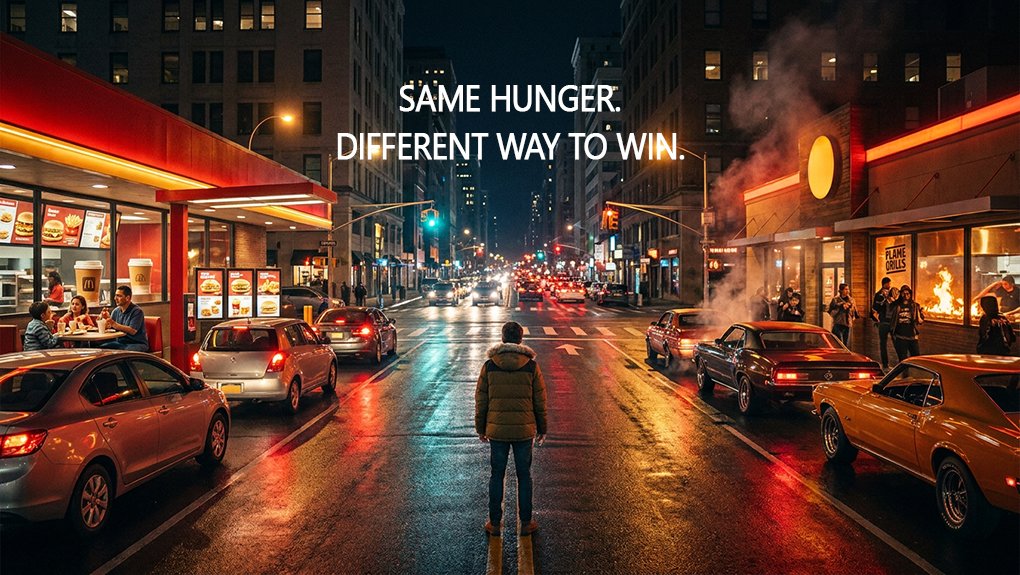
They sell similar meals to similar customers, often on the same streets. Yet McDonald’s and Burger King built remarkably different ways of persuading people to choose them.
Some rivalries are created by radically different products.
Others become powerful precisely because the products appear so similar.
A burger.
Fries.
A soft drink.
A quick meal.
A familiar restaurant on the road ahead.
For decades, McDonald’s and Burger King have competed for essentially the same moment.
You are hungry.
You want something familiar.
You want it quickly.
And somewhere nearby, two enormous brands are trying to persuade you that their version of that experience is the one you should choose.
At first glance, this might appear to be one of the simplest rivalries in business.
Two burger chains.
Two menus.
Two sets of restaurants.
Two famous flagship burgers.
But underneath that apparent simplicity lies a much more interesting strategic contest.
McDonald’s built extraordinary power through scale, consistency, accessibility and operational discipline.
Burger King developed much of its competitive personality by refusing to behave like the market leader.
One became the standard against which the category was often measured.
The other learned how to challenge that standard.
Their rivalry therefore became about much more than hamburgers.
It became a contest between two different ways of winning the same appetite.
WHEN FAST FOOD BECAME A SYSTEM
The hamburger existed long before either company became globally famous.
What changed the business was not simply the food.
It was the system around the food.
Speed.
Standardisation.
Repeatability.
Location.
Pricing.
Kitchen design.
Supply chains.
Franchising.
Brand recognition.
The genius of modern fast food was turning a meal into a predictable experience.
Customers no longer needed to ask what kind of restaurant they were entering.
The signs, colours, menu boards and packaging told them.
More importantly, they could develop expectations before they walked through the door.
McDonald’s became exceptionally powerful at this.
The promise was not that every meal would surprise you.
The promise was almost the opposite.
You knew what was coming.
A Big Mac in one city was expected to feel recognisably like a Big Mac somewhere else.
The fries had a familiar shape.
The packaging looked familiar.
The restaurant operated within a recognisable system.
Predictability became part of the product.
And once that system reached enormous scale, it became extraordinarily difficult to compete with directly.
THE POWER OF BEING EVERYWHERE
Scale creates advantages that are easy to see.
More restaurants create more customer access.
More customers create greater purchasing power.
More advertising creates greater familiarity.
More familiarity creates more visits.
More visits support more locations.
The cycle reinforces itself.
But scale creates another advantage that is less obvious.
It reduces the amount of decision-making required from the customer.
When people are travelling, tired, in a hurry or feeding a family, familiarity has value.
They do not necessarily want to investigate ten alternatives.
They want to recognise one.
That is why physical availability and mental availability can reinforce each other so powerfully.
McDonald’s built both.
By the end of 2025, the company had more than 45,000 restaurants globally, with roughly 95% of its restaurants franchised. Its 2025 revenue was about $26.9 billion.
Those numbers matter.
But the strategic significance lies behind them.
McDonald’s does not merely sell food at enormous scale.
Its scale itself becomes part of the competitive proposition.
The Golden Arches tell customers:
You know us. You know what happens here.
For a challenger, that creates a problem.
How do you compete with familiarity?
Burger King’s answer was not simply to become another McDonald’s.
It needed to give consumers a reason to choose differently.
THE WHOPPER NEEDED TO MEAN SOMETHING DIFFERENT
Burger King’s most important product became the Whopper.
That gave the company an anchor.
But a flagship product alone does not create differentiation.
The consumer needs a reason to believe it represents something distinctive.
Burger King found one in flame grilling.
Where McDonald’s could emphasise familiarity, convenience and the strength of its system, Burger King could talk about taste in a different way.
Flame-grilled.
That distinction became strategically valuable because it was easy to understand.
Consumers did not need a complicated product demonstration.
The cooking method itself communicated difference.
It suggested fire.
Grilling.
Smokiness.
A different burger experience.
Burger King still emphasises flame grilling as central to the Whopper today. In February 2026, when it announced its first substantial Whopper update in nearly a decade, it retained the flame grilled beef proposition while changing elements including the bun, toppings and packaging.
This is one of the oldest lessons in competitive strategy.
When your competitor owns the category standard, do not merely claim to be another version of the standard.
Find a meaningful difference.
Then repeat it until consumers can remember it.
HAVE IT YOUR WAY
Burger King found another powerful distinction in customisation.
“Have It Your Way” was more than an advertising line.
Strategically, it positioned Burger King against the perception of fast food as rigid standardisation.
The fast food system says:
This is how the product comes.
Burger King answered:
You can have it your way.
That may sound ordinary today because customisation has become common across many food businesses.
But conceptually, it created an interesting contrast.
McDonald’s represented the extraordinary efficiency of a standardised system.
Burger King could represent individual preference within the system.
Both were selling speed.
Both were selling burgers.
But they could attach different meanings to the experience.
That is how mature categories remain competitive.
The functional differences may be relatively small.
The perceived differences can become enormous.
THEN CAME THE BIG MAC
Every great rivalry needs symbols.
For McDonald’s, few products have become more symbolic than the Big Mac.
For Burger King, it is the Whopper.
They are more than menu items.
They are shorthand for their respective brands.
That matters because flagship products simplify marketing.
A large restaurant menu can contain dozens of items.
Consumers cannot emotionally attach themselves to all of them.
But one signature product can carry the identity of the entire organisation.
Think of what happens when someone says Big Mac.
They do not merely picture ingredients.
They picture McDonald’s.
The same happens with the Whopper and Burger King.
The product becomes a brand asset.
And once that happens, every new campaign around the product strengthens not only the product but the larger brand system surrounding it.
TWO BURGERS. TWO PERSONALITIES.
This is where the rivalry becomes especially interesting.
Over time, McDonald’s and Burger King developed different personalities.
McDonald’s generally had more to protect.
The larger the brand, the greater the consequences of appearing unstable, inconsistent or unnecessarily provocative.
Its communication could be playful, emotional, nostalgic or culturally relevant.
But the underlying brand needed to remain broadly accessible.
Burger King had greater freedom to behave like a challenger.
Challenger brands can often say things leaders cannot.
They can tease.
Provoke.
Compare.
Interrupt.
Mock conventions.
Even mention the competitor.
This asymmetry is crucial.
A smaller competitor does not always need to beat the leader at the leader’s game.
Sometimes it can force the leader to play a different game.
THE ADVANTAGE OF HAVING A BIGGER ENEMY
There is an unusual benefit to competing against a much larger brand.
Everyone already knows who your opponent is.
That means you can borrow some of its fame.
Burger King has repeatedly used McDonald’s as a reference point in advertising and promotions.
The strategy works because the audience understands the rivalry immediately.
No explanation is required.
If Burger King makes a joke about McDonald’s, consumers already know the characters.
The category becomes theatre.
McDonald’s plays the giant.
Burger King plays the challenger.
And the challenger often gets the better punchlines.
This does not mean the smaller company suddenly becomes larger.
It means it can occasionally become louder than its size.
That distinction matters enormously in marketing.
Market share and share of conversation are not the same thing.
WHEN YOUR COMPETITOR BECOMES YOUR MEDIA CHANNEL
Few campaigns illustrate this challenger mentality better than Burger King’s Whopper Detour.
In 2018, Burger King wanted consumers to download and use its mobile app.
It could have advertised the app conventionally.
Instead, it turned McDonald’s locations into part of the promotion.
Consumers near participating McDonald’s restaurants could unlock a one-cent Whopper offer through the Burger King app and then be directed to the nearest Burger King to collect it.
The campaign geofenced more than 14,000 McDonald’s locations.
Think about the strategic inversion.
McDonald’s had vastly more locations in the United States.
That was an advantage.
Burger King temporarily turned that advantage into media infrastructure for Burger King.
The campaign reportedly generated 1.5 million app downloads during its nine-day run, helped push the app to the top of major app store rankings and substantially increased mobile sales.
That is challenger thinking at its most elegant.
Do not complain that the competitor has more locations.
Ask:
How can their advantage become part of our idea?
THE RIVALRY LEARNED TO LAUGH
Traditional corporate competition often tries to appear serious.
Fast food rivalry discovered the opposite could be more powerful.
Humour made competition entertaining.
Burger King became particularly willing to poke at McDonald’s.
But the broader significance goes beyond individual advertisements.
The rivalry taught consumers to participate.
People could debate Big Mac versus Whopper.
McDonald’s fries versus Burger King’s fries.
Breakfast.
Chicken.
Value meals.
Portion sizes.
Taste.
Advertising.
The rivalry became conversational.
And conversation is valuable because consumers begin doing part of the marketing themselves.
The brand no longer has to initiate every comparison.
Customers carry the comparison into everyday life.
Which one do you prefer?
That simple question keeps both brands mentally present.
McDONALD’S DID NOT NEED TO ANSWER EVERY PROVOCATION
There is another lesson here.
Not responding can also be strategy.
When a challenger attacks a market leader, the leader faces a dilemma.
Respond too aggressively and you validate the challenger.
Ignore everything and you risk appearing disconnected.
The correct response depends on context.
McDonald’s enormous scale means it does not need to treat every Burger King provocation as an existential threat.
That itself communicates power.
Leaders and challengers therefore operate under different communication rules.
Burger King can gain attention by naming McDonald’s.
McDonald’s does not automatically gain the same amount of value by naming Burger King.
This is why copying a competitor’s marketing behaviour can be strategically foolish.
What works for the challenger may not work for the leader.
Position determines behaviour.
THE REAL BATTLE IS FOR OCCASIONS
It is tempting to think McDonald’s and Burger King compete for burger buyers.
But people do not organise their lives into product categories.
They organise them around moments.
Breakfast before work.
Lunch between meetings.
A quick meal on a road trip.
Food after a late night.
Something inexpensive for the family.
Coffee on the move.
A snack between destinations.
Delivery at home.
A craving.
A convenience decision.
This means the real competitive unit is not necessarily the burger.
It is the occasion.
And once you understand that, the competitive set expands.
McDonald’s is not competing only with Burger King.
Burger King is not competing only with McDonald’s.
Both compete with pizza, fried chicken, sandwiches, coffee shops, convenience stores, delivery platforms, local restaurants and sometimes the food already sitting in someone’s refrigerator.
The question becomes:
Who owns the appetite at this particular moment?
That is a much bigger battlefield.
BREAKFAST CHANGED THE CLOCK
Fast food brands once competed heavily around lunch and dinner.
Breakfast changed the economics of the restaurant.
The same location could serve customers during another part of the day.
McDonald’s developed enormous recognition in breakfast through products such as the Egg McMuffin and later through expanded breakfast offerings.
That matters because every additional daypart creates another competitive opportunity.
Morning.
Lunch.
Afternoon.
Dinner.
Late night.
The restaurant does not move.
But the reasons to visit multiply.
This is another reason the rivalry extends beyond flagship burgers.
If one company can create stronger reasons to visit at different times, it extracts more value from the same physical network.
Competition therefore becomes partly a battle against the clock.
THEN COFFEE BECAME PART OF THE FIGHT
Coffee illustrates how category boundaries blur.
A consumer buying morning coffee may not think they are participating in the burger business at all.
But from the restaurant’s perspective, the visit matters.
Coffee can create frequency.
Frequency creates habit.
Habit creates additional purchasing opportunities.
McCafé helped McDonald’s extend its relevance beyond traditional fast food.
Burger King has also developed breakfast and beverage offerings.
The strategic principle is larger than either menu.
Once a company owns locations, kitchens, drive-through lanes, digital ordering systems and customer traffic, it naturally asks:
What else can this infrastructure sell?
That is how competition expands.
The restaurant remains the same.
The appetite becomes broader.
THE DRIVE-THROUGH BECAME A COMPETITIVE WEAPON
Convenience has always mattered in fast food.
The drive-through turned convenience into infrastructure.
Customers could order without leaving their cars.
Speed became measurable.
Queue management became strategic.
Menu design affected ordering time.
Kitchen operations affected vehicle throughput.
Location design affected capacity.
A few seconds multiplied across millions of transactions could become economically meaningful.
This is where glamorous advertising meets unglamorous operational reality.
A brilliant campaign may bring customers to the restaurant.
But if the queue is too long, the order is wrong, or the experience is frustrating, marketing has simply advertised disappointment.
McDonald’s scale has long made operational efficiency central to its business.
Burger King faces the same reality.
The rivalry may be visible in advertising.
But it is won or lost repeatedly in kitchens, drive-through lanes and franchise operations.
DIGITAL ORDERING CHANGED THE COUNTER
Then the smartphone entered the restaurant.
Ordering no longer had to begin at the counter.
Apps introduced loyalty programmes, personalised offers, digital coupons, delivery integration and mobile ordering.
This changed the economics of customer relationships.
Previously, a restaurant might know very little about the person buying a meal.
Digital platforms can create a continuing relationship.
Frequency becomes visible.
Offers can become more targeted.
Customers can be encouraged to return.
The physical restaurant becomes connected to a digital ecosystem.
That is why the Whopper Detour was strategically more significant than a clever joke.
The stunt generated attention.
But the real asset was getting Burger King’s app onto consumers’ phones.
The promotion lasted days.
The customer relationship could last much longer.
VALUE IS A BATTLE WITH NO PERMANENT WINNER
Fast food has always had a complicated relationship with price.
Consumers expect affordability.
Franchisees need profitability.
Ingredients cost money.
Labour costs money.
Property costs money.
Technology costs money.
Marketing costs money.
Yet the category is highly price sensitive.
This creates constant pressure around value menus, meal bundles, promotions and discounting.
But value is not identical to cheapness.
Consumers evaluate:
How much food am I getting?
How much do I enjoy it?
How convenient is it?
How much time does it save?
Does the experience feel worth the price?
This gives both brands room to compete without simply racing towards the lowest possible number.
The strongest value proposition is not necessarily:
We cost less.
It is:
What you receive feels worth what you paid.
LOCAL TASTES CHALLENGED GLOBAL STANDARDISATION
Global expansion created another fascinating tension.
A worldwide brand benefits from consistency.
But appetites are local.
Religious practices differ.
Dietary preferences differ.
Spice preferences differ.
Meal habits differ.
Cultural expectations differ.
A rigidly identical menu everywhere would ignore these realities.
Both McDonald’s and Burger King therefore had to learn one of global branding’s hardest lessons:
standardise the brand without standardising every expression of the brand.
India provides an especially clear example.
A global burger brand entering India cannot simply reproduce an American menu and assume cultural compatibility.
Menus adapt.
Ingredients change.
Vegetarian choices become more important.
Local flavours enter the system.
Yet the restaurant still needs to feel unmistakably like the global brand.
This balancing act is difficult.
Too much standardisation can make a brand culturally tone deaf.
Too much localisation can dilute what made the brand recognisable.
Global scale requires local intelligence.
THE FRANCHISEE IS PART OF THE RIVALRY
Consumers usually see McDonald’s and Burger King as singular companies.
Operationally, the picture is more complicated.
Franchising is central to both systems.
That means competition happens through networks of business owners operating under common brands.
For McDonald’s, approximately 95% of restaurants were franchised at the end of 2025.
Burger King also operates predominantly through a franchised model within Restaurant Brands International’s global network.
This matters because corporate strategy must ultimately work at restaurant level.
A campaign can be brilliant at headquarters.
But franchisees need traffic.
They need margins.
They need workable operations.
They need equipment, staffing and supply systems capable of delivering what marketing promises.
Brand competition therefore has two audiences.
The customer must believe the proposition.
The franchise system must be able to deliver it.
SIZE DOES NOT ELIMINATE VULNERABILITY
McDonald’s scale is formidable.
But scale does not make a company immune to change.
Large systems can be difficult to move.
Consumer tastes evolve.
Health expectations change.
Technology changes ordering behaviour.
Delivery changes location economics.
New competitors emerge.
Economic pressure changes what consumers consider affordable.
Burger King faces many of the same pressures while also confronting the challenge of competing against a much larger restaurant network.
Restaurant Brands International, Burger King’s parent company, reported more than 33,000 restaurants across its four brands in over 120 countries and territories at the end of 2025. Its brands generated nearly $47 billion in annual system-wide sales. Those figures include Tim Hortons, Popeyes and Firehouse Subs as well as Burger King, so they should not be compared directly with McDonald’s company figures.
The broader lesson is more useful than a scoreboard.
Neither company competes in a frozen market.
Scale protects.
But it also creates something that must constantly be maintained.
WHAT McDONALD’S FORCED BURGER KING TO BECOME
Without McDonald’s, Burger King might have developed differently.
A dominant competitor creates pressure for clarity.
If the leader owns familiarity, the challenger needs differentiation.
If the leader has more locations, the challenger needs reasons to travel past one.
If the leader dominates attention, the challenger needs communication people notice.
If the leader defines the category, the challenger needs to question the definition.
That pressure helped Burger King develop a distinctive challenger personality.
Flame grilling.
The Whopper.
Customisation.
Comparative advertising.
Provocation.
Humour.
The competitor helped sharpen the brand.
This is one of the recurring patterns across THE ARENA.
Rivals do not merely take customers from one another.
They help determine what each other becomes.
WHAT BURGER KING FORCED McDONALD’S TO DEFEND
The pressure works in the opposite direction too.
A leader cannot assume leadership is self-sustaining.
Burger King’s existence gives consumers an alternative.
That alternative forces comparison.
Taste can be compared.
Value can be compared.
Portion can be compared.
Advertising can be compared.
Digital experiences can be compared.
Restaurant environments can be compared.
When a challenger publicly questions the leader, the leader’s assumptions become visible.
McDonald’s therefore cannot simply be large.
It has to keep making largeness useful.
Convenience must remain convenient.
Familiarity must not become boredom.
Consistency must not become complacency.
Scale must continue producing value.
A challenger keeps asking the leader:
Are you still as good as everyone assumes you are?
THE SAME APPETITE DOES NOT MEAN THE SAME STRATEGY
This may be the most important lesson of the rivalry.
McDonald’s and Burger King can sell remarkably similar categories of food without needing identical strategies.
One can derive power from scale.
The other can derive energy from challenging scale.
One can make familiarity reassuring.
The other can make difference provocative.
One can afford to ignore some competitive noise.
The other can turn competitive noise into attention.
That is why competitive strategy should never begin with:
What is our competitor doing?
It should begin with:
What position do we occupy relative to them?
Only then can a company decide how it should behave.
COMPETING FOR THE SAME APPETITE
Imagine the consumer again.
Hungry.
Driving.
Walking through a city.
Opening a delivery app.
Looking at a menu.
Thinking about lunch.
The decision may take seconds.
McDonald’s and Burger King have spent decades preparing for those seconds.
They built restaurants.
Supply chains.
Franchise systems.
Advertising characters.
Slogans.
Apps.
Loyalty programmes.
Menus.
Breakfast businesses.
Drive-through systems.
Delivery networks.
Flagship products.
Distinctive visual identities.
And billions of individual memories.
All so that when hunger becomes a decision, one brand enters the mind before the other.
That is what makes this rivalry so fascinating.
The product appears simple.
The competitive machinery behind it is anything but.
McDonald’s and Burger King are not merely competing to make a better burger.
They are competing to become the easiest, strongest or most interesting answer to a recurring human question:
What shall I eat?
And because that question returns every day, the rivalry never really ends.
Yesterday’s meal does not secure tomorrow’s customer.
The appetite returns.
So does the competition.
FROM THE ARENA TO CLASH OF THE TITANS
McDonald’s versus Burger King is one of the 40 iconic brand rivalries explored in Clash of the Titans.
The book looks beyond the products to examine the strategic choices, competitive moves and market pressures that made these battles so enduring.
Because competitors do not always need different customers to create different strategies.
Sometimes they can spend decades chasing the very same appetite.
— Jitendra Sheth, author of Clash of the Titans