
|
Getting your Trinity Audio player ready...
|
Two companies began by helping athletes perform. Their rivalry helped turn sportswear into culture, identity and one of the world’s most visible forms of self-expression.
There are products we buy because we need them.
And there are products we wear because they say something about us.
A running shoe begins as equipment.
It needs cushioning, grip, stability, durability and performance.
But somewhere along the journey from the athletics track to the street, something remarkable happened.
The shoe became a statement.
The jersey became an identity.
The athlete became a storyteller.
The logo became a cultural symbol.
And two companies helped drive that transformation more than most.
Nike and Adidas.
Their rivalry stretches across running tracks, football pitches, basketball courts, Olympic stadiums, fashion shows, music, celebrity culture and city streets.
They compete through technology and design.
They compete for athletes and teams.
They compete for cultural relevance.
They compete for the right to appear in moments people remember.
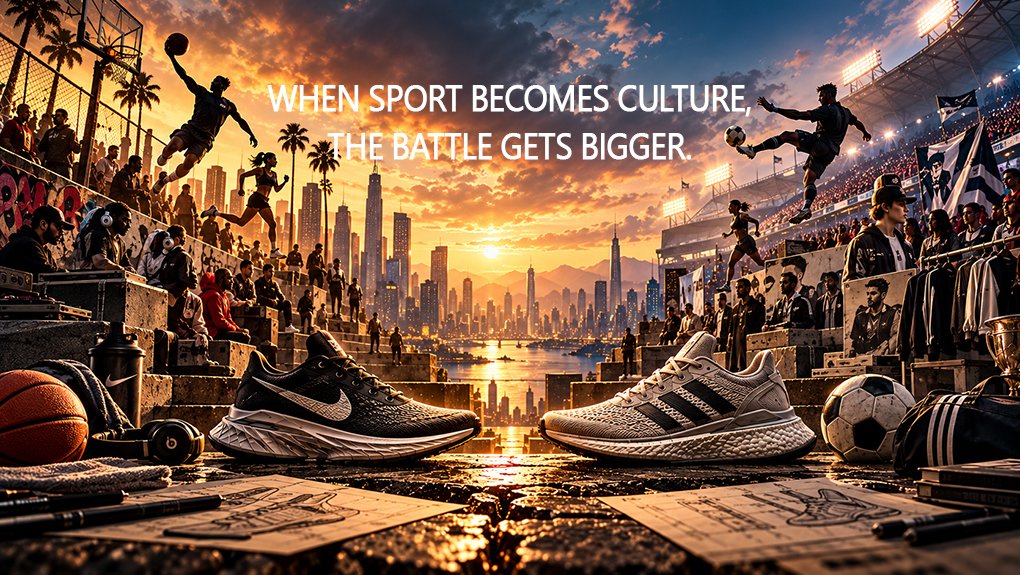
That is why Nike versus Adidas is not really a battle about shoes.
It is a battle about what the shoe represents.
TWO BRANDS. TWO DIFFERENT BEGINNINGS.
Adidas emerged from Germany with sport at the centre of its identity.
Its early strength was rooted in athletic performance, particularly football and track and field. Over decades, the three stripes became visible across some of the world’s biggest sporting stages.
Nike arrived later.
Founded in the United States as Blue Ribbon Sports before becoming Nike, it entered a market in which Adidas already possessed substantial sporting credibility.
But challengers have one advantage incumbents often do not.
They have less history to protect.
Nike could build differently.
It combined performance innovation with an increasingly powerful understanding of athletes as personalities and stories.
The rivalry that followed would eventually become bigger than either company’s original category.
Both would discover that the real market was not simply footwear.
It was aspiration.
WHEN ATHLETES BECAME MORE THAN ENDORSERS
Sports brands have long understood the value of successful athletes.
Victory creates credibility.
If the fastest runner wears your shoe, speed becomes associated with your brand.
If the winning football team wears your jersey, some of that triumph belongs visually to you.
But Nike helped push athlete marketing into something deeper.
The athlete was no longer simply evidence that a product performed.
The athlete could become part of the brand itself.
Michael Jordan changed that equation dramatically.
The relationship between Nike and Jordan evolved far beyond a conventional endorsement. Air Jordan became a commercial and cultural universe of its own, connecting basketball, sneakers, streetwear, collecting and popular culture.
That changed the competitive landscape.
An athlete was no longer merely someone who appeared in advertising.
An athlete could become intellectual and cultural property around which an entire business could grow.
Adidas responded through its own portfolio of athletes, clubs, teams and cultural collaborators.
The competition for sporting talent therefore became a competition for something larger:
meaning.
THE BATTLE FOR THE MOMENT
There is a peculiar characteristic of sports marketing.
Companies cannot manufacture the most valuable moments.
They can only position themselves close enough to participate in them.
A World Cup final cannot be scripted.
An Olympic record cannot be scheduled by a marketing department.
A championship-winning shot cannot be storyboarded.
But when those moments happen, millions of people see the shoes, jerseys and symbols attached to them.
That makes sporting sponsorship unusually powerful.
Nike and Adidas therefore compete not only for athletes.
They compete for moments that may become history.
The Olympics.
The FIFA World Cup.
Grand Slam tennis.
Major marathons.
Championship basketball.
International football.
Every major sporting stage offers another opportunity for performance to become visibility.
And sometimes the rivalry becomes visible even before the competition begins.
In 2024, Adidas launched footwear covering 41 Olympic disciplines as it sought broader sporting relevance around the Paris Games.
Meanwhile, one of the most symbolic battles in football sponsorship occurred when Nike secured the future German national team kit contract from 2027, ending Adidas’s approximately 70-year relationship with the German Football Association. Adidas CEO Bjørn Gulden said the company chose not to match Nike’s offer because it did not believe the economics justified doing so.
That episode illustrates something important.
Rivalry creates pressure.
But good strategy still requires knowing when not to compete at any price.
FOOTBALL: WHERE THE RIVALRY BECOMES GLOBAL
If basketball helped Nike turn the individual athlete into a cultural force, football gave Adidas something different:
global continuity.
For decades, Adidas has been deeply embedded in the world’s most watched sport.
Its presence has extended across teams, players, boots, tournaments and the FIFA World Cup match ball.
Nike challenged that territory aggressively.
The result has been one of sports marketing’s most visible contests.
At the 2014 World Cup, for example, Nike outfitted more participating national teams than Adidas for the first time, although Adidas supplied both finalists and continued its long-standing role as supplier of the tournament’s official ball.
More than a decade later, the same rivalry remains highly visible. At the 2026 World Cup, Reuters reported that Nike was outfitting 12 national teams while Adidas was sponsoring 14 and supplying the official match ball.
The scoreboard changes.
The battle continues.
But the strategic prize extends far beyond football boots.
Football gives both brands access to emotion at extraordinary scale.
National pride.
Club loyalty.
Heroes.
Rivalries.
Victory.
Defeat.
Memory.
The product becomes attached to experiences consumers may remember for the rest of their lives.
That is extraordinarily difficult for conventional advertising to reproduce.
NIKE LEARNED TO SELL BELIEF
One of Nike’s greatest achievements was understanding that sports marketing did not have to talk constantly about sport.
It could talk about the psychology behind sport.
Ambition.
Fear.
Failure.
Discipline.
Defiance.
Possibility.
The famous Nike philosophy built around “Just Do It” transformed a product proposition into a human proposition.
You did not need to be an Olympic champion to understand it.
You only needed to have something you had been postponing.
That widened the brand dramatically.
Nike was still selling shoes and apparel.
But psychologically, it was selling permission to act.
This is one of the most powerful things a brand can achieve.
When the consumer can apply the brand idea to their own life, the communication escapes the category.
A sports brand becomes a personal philosophy.
ADIDAS LEARNED TO MOVE BETWEEN SPORT AND STYLE
Adidas developed a different cultural strength.
Its sporting heritage gave the brand authenticity.
But many of its most recognisable products escaped their original sporting context.
Shoes designed around athletic use became streetwear.
Tracksuits became fashion.
The three stripes travelled from stadiums into music, youth culture and everyday wardrobes.
Products such as the Superstar and Stan Smith demonstrated an important truth about sportswear:
Performance heritage can become cultural heritage.
The person wearing the shoe does not necessarily need to participate in the sport that created it.
That changes the size of the market.
A tennis shoe no longer belongs only to tennis players.
A basketball shoe no longer belongs only to basketball players.
A football jersey no longer belongs only inside a stadium.
Once sport enters culture, the product acquires a second life.
THEN MUSIC ENTERED THE RIVALRY
The boundaries continued to dissolve.
Athletes were no longer the only people capable of giving sportswear credibility.
Musicians, designers and cultural figures could influence what people wanted to wear just as powerfully.
This changed the competitive battlefield again.
Adidas collaborated across music and fashion, including a highly successful partnership with Kanye West, now known as Ye.
West had previously worked with Nike before moving to Adidas. Reuters reported in 2016 that he said Adidas offered greater creative freedom and royalties. The expanded Adidas partnership was intended to stretch beyond footwear into apparel, accessories and dedicated retail concepts.
Yeezy became commercially significant.
But it also demonstrated the risk inherent in building substantial brand value around an individual personality.
Adidas terminated the Ye partnership in October 2022 after comments and actions the company described as unacceptable, hateful and dangerous. Adidas said at the time that ending the relationship was expected to reduce its 2022 net income by as much as €250 million. Adidas Group
There is a larger lesson here.
Celebrity can transfer attention to a brand.
But the relationship works in both directions.
The brand also inherits some of the celebrity’s risk.
THE SHOE BECOMES A CULTURAL OBJECT
At some point, sneakers stopped being consumed like ordinary footwear.
People began collecting them.
Displaying them.
Trading them.
Waiting in queues for them.
Following release calendars.
Discussing colourways.
Building communities around them.
A functional object developed cultural scarcity.
Nike and Adidas both helped create this environment, although through different histories and collaborations.
The transformation matters because it changes the basis of value.
A shoe might cost a certain amount to manufacture.
Its performance characteristics might justify another level of value.
But culture can create an entirely different layer.
Story.
Scarcity.
Association.
History.
Identity.
Belonging.
These cannot be measured simply by examining the materials in the shoe.
The physical product remains important.
But increasingly, consumers are buying the world around the product.
WHEN PERFORMANCE AND FASHION COLLIDE
The rivalry also helped erase the old boundary between sportswear and fashion.
Once, athletic clothing belonged primarily in sporting environments.
Today, sneakers can appear in offices, restaurants, airports, concerts and fashion events.
Tracksuits can become luxury collaborations.
Performance silhouettes can influence streetwear.
Fashion designers can reinterpret sports products.
Athletes can become fashion figures.
Musicians can become sneaker designers.
The category has expanded because the cultural rules governing where sportswear belongs have changed.
Nike and Adidas did not accomplish this alone.
Many brands, designers, athletes and subcultures contributed.
But the scale and visibility of their rivalry helped accelerate the transformation.
Every successful crossover created pressure on the other to remain culturally relevant.
Once again, rivalry expanded the market it was fighting over.
INNOVATION STILL MATTERS
Culture may dominate the conversation, but neither company can survive on storytelling alone.
Performance remains fundamental.
Running shoes still need to help runners.
Football boots still need grip, control and responsiveness.
Basketball shoes still need to address movement, cushioning and stability.
Materials matter.
Weight matters.
Comfort matters.
Manufacturing matters.
Technology matters.
That creates a fascinating tension.
Sportswear brands must operate simultaneously in two worlds:
science and symbolism.
The laboratory asks:
Can we make the athlete perform better?
Culture asks:
Can we make people care?
The strongest products often answer both questions.
THE NUMBERS SHOW HOW FAR BEYOND SHOES THE BATTLE HAS MOVED
These companies remain enormous commercial organisations.
For its fiscal year ended May 31, 2025, Nike reported revenues of $46.3 billion, including $44.7 billion from the Nike brand. Nike brand footwear generated $29.5 billion, while apparel contributed almost $13 billion.
Adidas reported record net sales of €24.8 billion for calendar 2025. Footwear accounted for €14.2 billion, apparel €8.8 billion and accessories €1.8 billion. The Adidas brand grew 13% on a currency-neutral basis during the year.
The reporting periods and currencies differ, so those figures should not be treated as a direct like-for-like comparison.
What they demonstrate instead is scale.
The rivalry is no longer contained inside a footwear store.
It spans apparel, equipment, digital commerce, wholesale, direct retail, collaborations, sport, lifestyle and global culture.
THE DANGER OF BECOMING TOO POWERFUL
Dominant brands face a problem challengers rarely experience.
Eventually, success itself can become an obstacle.
The bigger the brand becomes, the easier it is to assume consumers will continue wanting what worked before.
But culture changes.
Athletes change.
Fashion changes.
Retail changes.
Technology changes.
New competitors emerge.
Running, for example, has attracted brands capable of challenging established assumptions around footwear design and consumer loyalty.
No brand owns relevance permanently.
Nike’s fiscal 2025 results provided a reminder of this. Revenue fell 10% on a reported basis to $46.3 billion, and the company acknowledged that its results were not where it wanted them to be.
Adidas, meanwhile, reported strong momentum in 2025, including double-digit currency-neutral growth across multiple categories and sports.
Those figures describe a particular reporting period, not a permanent competitive order.
And that is precisely the point.
Leadership moves.
Momentum changes.
The rivalry continues.
THE COMPETITION IS NO LONGER ONLY BETWEEN TWO COMPANIES
Nike versus Adidas remains iconic.
But the modern sportswear landscape is becoming more crowded.
Specialist running brands have grown.
Fashion has entered performance.
Performance brands have entered lifestyle.
New technologies have created different forms of differentiation.
Athletes have become media platforms in their own right.
Consumers can discover emerging brands through social media without waiting for traditional advertising.
Even established stars can move.
In September 2026, Reuters reported that Kylian Mbappé had joined Swiss brand On after roughly two decades associated with Nike, as On sought to establish itself in football.
That illustrates how the battlefield continues to widen.
Nike and Adidas are still competing with each other.
But both are increasingly competing with a market that their own success helped create.
THE REAL PRODUCT IS IDENTITY
This may be the deepest lesson of the Nike-Adidas rivalry.
People rarely describe themselves through technical product specifications.
They describe themselves through identity.
Runner.
Football supporter.
Basketball fan.
Sneaker collector.
Athlete.
Creator.
Rebel.
Minimalist.
Fashion enthusiast.
Member of a tribe.
Brands become powerful when they find a meaningful place inside those identities.
That is why two shoes with similar functional purposes can generate completely different emotional responses.
Consumers are not only asking:
What does this product do?
They are also asking:
What does choosing it say about me?
Once that happens, competition changes.
You are no longer fighting only for market share.
You are fighting for cultural meaning.
WHAT NIKE FORCED ADIDAS TO CONFRONT
Nike demonstrated how aggressively storytelling could expand the meaning of sport.
Its athlete relationships, basketball culture, advertising and ability to turn sporting ambition into universal emotional language created a formidable model.
Adidas could not rely solely on heritage.
Heritage had to remain alive.
The company needed to keep moving between performance and lifestyle, football and fashion, elite sport and street culture.
A great rival does this.
It turns yesterday’s strengths into today’s questions.
WHAT ADIDAS FORCED NIKE TO REMEMBER
Adidas brought something equally important to the rivalry.
Depth of sporting heritage.
Global football credibility.
Products capable of repeatedly returning to fashion across generations.
A visual identity recognised almost anywhere.
And an ability to demonstrate that cultural relevance does not always need to be invented from scratch.
Sometimes it can be rediscovered.
For Nike, a strong Adidas is a reminder that novelty alone does not create longevity.
Brands also need roots.
THE BATTLE BEYOND THE SHOE
The easiest way to understand Nike versus Adidas is to look at their footwear.
The more interesting way is to look everywhere else.
Look at the stadium.
The music video.
The school corridor.
The fashion collaboration.
The basketball court.
The marathon.
The World Cup.
The concert.
The city street.
The collector’s shelf.
The social feed.
The shoe is present in all of them.
But its meaning keeps changing.
That is what this rivalry helped create.
Nike and Adidas began by competing to put better products on athletes.
Over time, they learned to put themselves inside culture.
And once that happened, the battle became much bigger than footwear.
They were no longer simply asking:
Who makes the shoe people want to wear?
They were competing over a much more powerful question:
Who gets to shape what wearing it means?
That is the battle beyond the shoe.
FROM THE ARENA TO CLASH OF THE TITANS
Nike versus Adidas is one of the 40 iconic brand rivalries explored in Clash of the Titans.
The book goes deeper into the strategic decisions, competitive moves and cultural forces that turned two sportswear companies into global symbols.
Because the strongest rivalries do more than divide markets.
Sometimes they help create the culture surrounding them.
— Jitendra Sheth, author of Clash of the Titans