
|
Getting your Trinity Audio player ready...
|
Market leaders define categories. But challengers often force those categories to move.
Being No. 1 sounds like the most powerful position in business.
You have scale.
Recognition.
Distribution.
Customers.
Resources.
History.
And perhaps most importantly, you have the psychological advantage of leadership.
Consumers know you.
Retailers want you.
Competitors watch you.
The market often uses you as its reference point.
So why do so many important changes in markets come from somewhere else?
Why does the brand chasing the leader so often introduce the provocation, the new proposition, the sharper advertising, the different business model or the uncomfortable question that changes the category?
Because being No. 2 creates something leadership can gradually remove.
Urgency.
The leader has a position to protect.
The challenger has a position to change.
That difference can transform an entire market.
THE ADVANTAGE OF NOT BEING NO. 1
Nobody builds a strategy around the ambition to remain second forever.
But second place can be strategically liberating.
The leader is surrounded by expectations.
Customers expect continuity.
Investors expect performance.
Partners expect stability.
Distribution systems expect predictability.
Employees understand established processes.
The organisation has built systems around what already works.
That success creates strength.
But it can also create boundaries.
The challenger has fewer boundaries.
If the current rules favour the leader, the challenger has little reason to respect them.
It can ask different questions.
Why does the product have to work this way?
Why does the category communicate this way?
Why is this customer being ignored?
Why is this price accepted?
Why is this distribution model necessary?
Why does everyone assume the leader’s advantage is permanent?
These questions are dangerous.
Not because every challenger finds the right answer.
Most do not.
But because one challenger asking the right question can expose an assumption that an entire industry has mistaken for a rule.
LEADERS DEFEND. CHALLENGERS DISTURB.
The strategic objectives of leaders and challengers are fundamentally different.
A leader wants to preserve an advantage.
A challenger wants to create movement.
That does not mean leaders stop innovating.
Many market leaders are among the world’s most innovative companies.
But innovation inside leadership comes with an additional calculation:
What might this change disrupt inside our existing business?
The challenger faces a different calculation:
What happens if we do nothing?
That produces very different attitudes towards risk.
For the leader, change can threaten existing revenue.
For the challenger, change can create future revenue.
For the leader, a radical new model may cannibalise a successful one.
For the challenger, there may be far less to cannibalise.
This is why challengers frequently appear impatient.
They have to be.
Time usually benefits the incumbent.
Movement benefits the challenger.
THE MARKET LEADER BECOMES THE REFERENCE POINT
One of the strangest advantages available to a challenger is that someone else has already explained the category.
Consumers know what a cola is.
They know what a hamburger is.
They know what a smartphone is.
They know what a sports shoe is.
They know what a rental car company does.
The challenger does not necessarily need to educate the market from zero.
Instead, it can position itself against what consumers already understand.
This changes the communication problem.
The challenger can effectively say:
You know them. Here is why we are different.
That is an extraordinarily efficient piece of positioning.
The leader becomes the reference point against which the challenger defines itself.
Sometimes the challenger does not even need to name the leader.
The audience already knows.
AVIS TURNED SECOND PLACE INTO A PROPOSITION
Few examples capture challenger thinking as clearly as Avis.
In the early 1960s, Avis was competing in a rental car market dominated by Hertz.
Ordinarily, being second would be treated as a weakness to disguise.
Avis did the opposite.
It made the disadvantage visible.
The logic was brilliantly simple.
If you are not No. 1, you have to work harder.
That idea transformed competitive weakness into a customer promise.
Second place no longer meant inferior.
It meant hungry.
Attentive.
Motivated.
Determined.
The strategic brilliance was not merely the advertising line.
It was the reframing.
Avis did not pretend the market hierarchy did not exist.
It used the hierarchy to explain its behaviour.
That is what great challenger positioning does.
It does not always erase weakness.
Sometimes it gives weakness a different meaning.
Avis itself dates the launch of “We Try Harder” to 1963.
THE POWER OF ADMITTING THE OBVIOUS
Brands often behave as though acknowledging a competitor makes them weaker.
Challenger brands frequently discover the opposite.
Consumers already understand market reality.
Pretending otherwise can make communication feel artificial.
Avis worked because the audience knew Hertz was larger.
The campaign did not ask people to forget that fact.
It used it.
This reveals a broader principle.
Credibility can begin with acknowledging what the customer already knows.
A challenger does not have to say:
We are the biggest.
It can say:
We care more.
We move faster.
We specialise.
We question conventions.
We offer something the leader does not.
We were built for customers the leader overlooks.
That can be more believable than attempting to imitate the language of leadership.
PEPSI MADE COMPARISON THE EVENT
Pepsi demonstrated another challenger technique.
If consumers assume the leader is better, challenge the assumption directly.
The Pepsi Challenge turned product comparison into public theatre.
Remove the labels.
Taste the drinks.
Choose.
The strategic idea was powerful because the market leader’s brand recognition was itself part of the problem.
So Pepsi temporarily removed branding from the decision.
It changed the rules of comparison.
Instead of asking:
Which cola brand do you normally buy?
The experiment asked:
Which one do you prefer when you cannot see the label?
The campaign became culturally significant because it transformed competitive comparison into participation.
Consumers were no longer merely watching two brands advertise.
They became judges.
Pepsi continues to use the challenger framing decades later, including renewed blind taste tests.
That tells us something important.
A challenger does not always need to persuade consumers that the leader is wrong.
Sometimes it can create a situation in which consumers question their own assumptions.
CHALLENGERS CHANGE THE QUESTION
This may be the most powerful weapon available to a No. 2 brand.
Do not merely provide a different answer.
Change the question.
If the leader asks:
Who has the greatest scale?
The challenger asks:
Who understands you better?
If the leader asks:
Who has the longest history?
The challenger asks:
Who is better prepared for what comes next?
If the leader asks:
Who offers the most?
The challenger asks:
Who does this one thing best?
If the leader asks:
Who is safest?
The challenger asks:
Who is more exciting?
Once the question changes, the leader’s advantage may become less decisive.
This is how categories move.
The challenger changes the criteria by which customers evaluate them.
DAVID DOES NOT BEAT GOLIATH BY BECOMING GOLIATH
One of the most common strategic mistakes challengers make is copying the leader.
The logic appears sensible.
The leader is successful.
Therefore, imitate what the leader does.
But imitation often reinforces the very hierarchy the challenger wants to change.
If your product looks like the leader’s product, your advertising sounds like the leader’s advertising, and your experience behaves like the leader’s experience, the customer eventually asks:
Why shouldn’t I simply buy the leader?
A challenger needs a reason to exist.
That reason does not have to involve everything.
It may be one meaningful difference.
Faster.
Simpler.
Cheaper.
More specialised.
More human.
More rebellious.
More convenient.
More transparent.
More technologically advanced.
More culturally relevant.
But something must break the symmetry.
Otherwise, the challenger becomes a smaller version of the company it is trying to challenge.
THE LEADER’S STRENGTH CAN BECOME THE CHALLENGER’S TARGET
Every competitive advantage has a corresponding vulnerability.
Scale can become bureaucracy.
Consistency can become sameness.
Heritage can become nostalgia.
Premium positioning can become exclusivity.
Breadth can become complexity.
Efficiency can become impersonality.
Specialisation can become narrowness.
Innovation can become instability.
The challenger looks at the leader’s greatest strength and asks:
What does the customer sacrifice in exchange for that strength?
That sacrifice can become the challenger’s opportunity.
This is not about inventing criticism for its own sake.
It is about understanding trade-offs.
No business model optimises everything simultaneously.
If the leader has made one set of choices extremely well, another set of possibilities usually remains open.
The challenger enters through that opening.
BURGER KING TURNED SCALE AGAINST McDONALD’S
We saw this in Blog 7.
McDonald’s had more restaurants.
That was obviously an advantage.
Burger King could not suddenly build thousands of additional restaurants for a campaign.
So it did something more interesting.
It turned the competitor’s physical footprint into part of its own communication.
The Whopper Detour promotion used geofencing around more than 14,000 McDonald’s locations to unlock a Burger King offer through its app.
The competitor’s scale became the challenger campaign’s infrastructure.
That is almost a textbook definition of challenger behaviour.
The obvious response to a competitor’s advantage is:
How do we match it?
The challenger response is:
How do we use it?
Those are very different questions.
CHALLENGERS HAVE TO EARN ATTENTION
Market leaders possess an enormous invisible asset.
Familiarity.
Consumers recognise them before advertising begins.
Retailers make space for them.
Media organisations notice them.
People discuss them.
Their products may already be part of everyday habits.
The challenger does not automatically receive that attention.
It must earn it.
That is why challenger advertising is often sharper.
More provocative.
More comparative.
More humorous.
More surprising.
Sometimes more polarising.
This is not simply a creative preference.
It is an economic necessity.
If you have less money, fewer locations and lower awareness, ordinary communication can disappear.
The challenger cannot always afford to whisper.
BUT PROVOCATION IS NOT A STRATEGY
This distinction matters.
Being loud does not make a company a challenger brand.
Mocking the market leader does not automatically create competitive advantage.
Provocation without substance becomes entertainment.
It may generate impressions.
It may win awards.
It may create social conversation.
But if the product, service or experience does not support the claim, the attention disappears.
The strongest challengers connect communication to a genuine strategic difference.
Avis connected “trying harder” to service.
Pepsi connected challenge to taste.
Burger King connected provocation to a distinct product and brand personality.
The message works because there is something underneath it.
A challenger needs more than attitude.
It needs an argument.
THE NO. 2 BRAND CAN MAKE NO. 1 BETTER
Here is where rivalry becomes productive.
A challenger does not have to overtake the leader to change the market.
It only has to become credible enough that the leader cannot ignore it.
Once that happens, the leader responds.
Prices change.
Products improve.
Advertising becomes sharper.
Customer experience receives investment.
Technology accelerates.
New categories appear.
Old assumptions are reconsidered.
The leader may remain No. 1.
But it is no longer the same No. 1.
Competition has changed it.
This is why market share alone cannot measure a challenger’s impact.
The challenger may have transformed the market without ever owning most of it.
APPLE AND SAMSUNG SHOW THE FEEDBACK LOOP
Our Apple versus Samsung rivalry illustrates this beautifully.
At different moments, each company has placed pressure on the other.
Screen size.
Camera capabilities.
Device ecosystems.
Design.
Displays.
Wearables.
Software integration.
Form factors.
The point is not that every innovation can be attributed neatly to one competitor.
Markets do not evolve so simply.
The point is that credible alternatives create pressure.
One company moves.
The other responds.
The response creates another move.
The cycle accelerates.
Eventually consumers begin treating yesterday’s innovation as today’s expectation.
Competition resets the baseline.
That is how rivals can collectively move an industry forward.
CHALLENGERS CAN MAKE THE CATEGORY MORE INTERESTING
A dominant brand can sometimes make a category feel settled.
The challenger introduces tension.
Suddenly there are sides.
Preferences.
Arguments.
Comparisons.
Identity.
Coke or Pepsi?
Nike or Adidas?
McDonald’s or Burger King?
Apple or Samsung?
The products become more than functional purchases.
They become choices people can discuss.
That conversation benefits the challenger because conversation creates visibility.
But interestingly, it can also benefit the leader.
The rivalry keeps the category culturally alive.
Competition creates narrative.
And narrative attracts attention.
THE PSYCHOLOGY OF SUPPORTING THE CHALLENGER
People have a complicated relationship with power.
We admire winners.
But we also enjoy watching established power being challenged.
The underdog creates emotional tension because the outcome feels less certain.
That makes challenger brands potentially attractive beyond functional product attributes.
Choosing the challenger can communicate something about the consumer.
Independence.
Individuality.
Rebellion.
Discovery.
A refusal to choose the obvious option.
This does not apply equally to every category or every person.
But where identity matters, challenger status can become emotionally valuable.
The market leader sells confidence.
The challenger can sell possibility.
NO. 2 IS A MINDSET, NOT JUST A RANKING
This distinction is essential.
A challenger brand is not simply whichever company appears second in a market share table.
A company can be third, fifth or twentieth and still behave like a challenger.
Likewise, a No. 2 company can behave like an incumbent.
Challenger status is partly structural.
But it is also psychological.
It involves refusing to accept that the current market configuration is inevitable.
A true challenger sees the category as unfinished.
There is always something to question.
Something to simplify.
Something to reinvent.
Something the leader has overlooked.
Something consumers tolerate because nobody has offered them an alternative.
That mindset matters more than the number printed beside the company’s market share.
SUCCESS CREATES A DANGEROUS QUESTION
What happens when the challenger succeeds?
This is where things become interesting.
The behaviour that helped a company challenge the establishment may become harder to maintain once it becomes established itself.
Growth creates systems.
Systems create procedures.
Procedures create consistency.
Consistency creates expectations.
Expectations create caution.
Eventually the challenger can become the incumbent.
Then another company begins asking uncomfortable questions about it.
This is one of capitalism’s recurring cycles.
The disruptor becomes the establishment.
The establishment becomes vulnerable to disruption.
Yesterday’s challenger becomes tomorrow’s target.
NETFLIX LEARNED THIS LESSON
Netflix once represented a fundamental challenge to established ways of consuming entertainment.
Its model helped change how audiences thought about access, schedules and eventually streaming.
But once streaming became mainstream, Netflix itself became part of the establishment.
New competitors entered.
Studios built direct relationships with audiences.
Content costs changed.
Subscription behaviour evolved.
The challenger became challenged.
The lesson is not specific to entertainment.
It applies to almost every dynamic market.
There is no permanent challenger.
There is no permanently secure incumbent.
Competitive positions evolve.
The mentality required to reach the top is not automatically the mentality that keeps you there.
CATEGORY LEADERSHIP CAN CREATE BLIND SPOTS
Success produces data.
And data can be dangerous when it describes only the world that already exists.
A market leader knows its current customers extremely well.
It knows what sells.
Which channels work.
Which products generate margin.
Which markets perform.
That knowledge is valuable.
But it can encourage the organisation to optimise the present instead of imagining a different future.
Challengers often have less historical data.
Paradoxically, that can liberate them.
They are forced to look at unmet demand rather than merely established demand.
They ask what customers might want rather than only what customers currently buy.
That does not guarantee insight.
But it creates room for it.
SMALLER CAN SOMETIMES MEAN FASTER
Large organisations possess resources challengers can only dream about.
But resources and speed are not identical.
Every large organisation has coordination costs.
More stakeholders.
More approvals.
More systems.
More territories.
More existing customers to consider.
More potential consequences when something goes wrong.
The challenger can sometimes move with fewer constraints.
Test something.
Change it.
Abandon it.
Try again.
This agility becomes especially important when technology or consumer behaviour is changing rapidly.
The leader may have more horsepower.
The challenger may have a tighter turning radius.
In a straight race, power matters.
On a changing road, manoeuvrability matters too.
CHALLENGERS OFTEN FIND THE CUSTOMER THE LEADER CANNOT SEE
Market leaders naturally concentrate on large opportunities.
They have large organisations to feed.
A niche may simply be too small to matter.
That creates openings.
A challenger can begin with customers the leader considers peripheral.
A different age group.
A different price point.
A different geography.
A different distribution channel.
A different cultural identity.
A different use case.
At first, the opportunity may look insignificant.
But niches can grow.
And challengers can grow with them.
What the leader dismisses as too small today can become the market everyone wants tomorrow.
THE INTERNET MADE CHALLENGING CHEAPER
Historically, scale created enormous communication advantages.
National advertising required money.
Retail distribution required relationships.
Media access was concentrated.
Building awareness was expensive.
Digital platforms changed some of those economics.
A challenger can now reach specific communities without buying mass media.
It can sell directly.
Build an audience.
Test propositions quickly.
Create content.
Generate word of mouth.
Use creators.
Build communities.
Collect first party customer relationships.
None of this makes competition easy.
Digital markets create their own forms of concentration and expense.
But they reduce some traditional barriers.
A small brand no longer needs to look large before it can sound interesting.
That matters.
THE BEST CHALLENGERS DO NOT ATTACK EVERYTHING
A challenger with limited resources cannot fight the leader everywhere.
Trying to do so is usually a mistake.
Instead, strong challengers choose the battlefield.
One product.
One audience.
One geography.
One customer frustration.
One cultural tension.
One distribution model.
One memorable difference.
Concentration creates disproportionate force.
The leader may possess ten times the resources.
But if those resources are distributed across dozens of priorities while the challenger concentrates on one vulnerable point, the local competitive balance can look very different.
This is strategy in its simplest form.
You do not need to be stronger everywhere.
You need to be strong enough somewhere that matters.
THE CHALLENGER’S GREATEST ENEMY MAY BE SUCCESS
Early challenger brands often possess remarkable clarity.
Everyone knows what they are fighting.
Everyone understands why the company exists.
The competitor is obvious.
The problem is obvious.
The difference is obvious.
Growth complicates that clarity.
New markets arrive.
New products appear.
New executives join.
New customer segments matter.
The company begins protecting what it has built.
Gradually, the question can shift from:
How do we change this market?
to:
How do we protect our position?
That is the moment the challenger begins becoming the incumbent.
There is nothing inherently wrong with that evolution.
Businesses need stability.
But strategically, something valuable can disappear.
Hunger.
THE LEADER NEEDS THE CHALLENGER TOO
This may sound counterintuitive.
Why would a market leader need the company trying to take its customers?
Because credible competition prevents complacency.
A strong rival creates an external deadline.
It makes weaknesses visible.
It forces priorities.
It gives innovation urgency.
It makes employees understand why improvement matters.
Without meaningful competition, organisations can begin competing primarily with their own history.
Last year’s sales.
Last year’s margins.
Last year’s product.
Last year’s campaign.
A challenger changes the benchmark.
Suddenly the question is not:
Are we improving?
It becomes:
Are we improving fast enough?
That is a much more demanding question.
THE CUSTOMER OFTEN WINS THE RIVALRY
Businesses naturally measure competition through market share, revenue and profitability.
But consumers experience rivalry differently.
Better products.
More choices.
Sharper prices.
Faster innovation.
Improved service.
Greater convenience.
New experiences.
More responsive companies.
This is one reason healthy competition matters.
The rivalry creates pressure that no mission statement can replicate.
A company may sincerely want to improve.
But wanting to improve and needing to improve are different forces.
A credible challenger turns improvement into necessity.
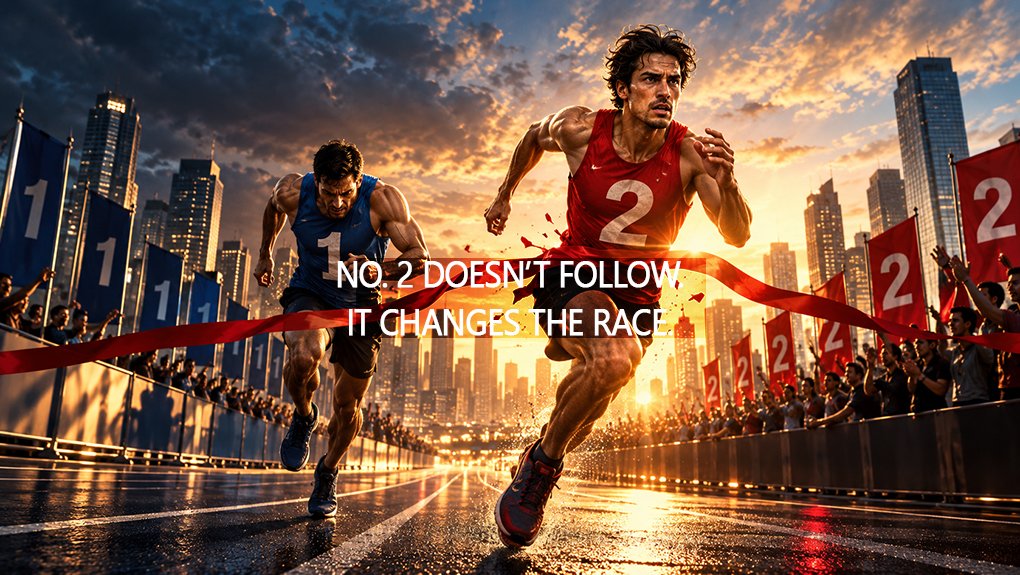
THE REAL POWER OF NO. 2
The power of the challenger does not come from being second.
It comes from refusing to behave as though second is permanent.
That creates a productive dissatisfaction.
The challenger looks at the leader’s advantages and searches for the disadvantages hidden inside them.
It looks at category conventions and asks who created them.
It looks at customer habits and asks whether they are loyalty or merely inertia.
It looks at its own limitations and asks whether they can force greater creativity.
Sometimes the challenger eventually becomes No. 1.
Sometimes it does not.
But overtaking the leader is not the only measure of influence.
If the challenger forces the leader to change, it has already changed the market.
If it creates a new expectation, it has changed the market.
If it makes consumers reconsider an assumption, it has changed the market.
If competitors begin copying something it introduced, it has changed the market.
The scoreboard tells us who leads.
It does not always tell us who caused the movement.
WHEN THE CHALLENGER BECOMES THE CATALYST
This is why some of the most fascinating companies are not necessarily the largest.
They are the ones that make everyone else react.
They introduce the question the category can no longer avoid.
They expose the compromise customers had stopped noticing.
They communicate in a way the establishment would never dare.
They turn limitations into positioning.
They turn competitors into reference points.
They turn dissatisfaction into momentum.
And sometimes they become large enough to discover the great irony of challenger brands:
Once you successfully change the market, you become part of the market that someone else wants to change.
There will always be another No. 2.
Another outsider.
Another uncomfortable question.
Another brand that believes the established rules are not rules at all.
That is why challengers matter.
No. 1 may own the market today.
But No. 2 may be deciding what that market becomes tomorrow.
FROM THE ARENA TO CLASH OF THE TITANS
Across the 40 iconic rivalries explored in Clash of the Titans, one pattern appears repeatedly: the company with the greatest market power is not always the company creating the greatest competitive pressure.
Challengers make leaders defend assumptions they once took for granted.
They sharpen differences, accelerate decisions and sometimes rewrite the rules of an entire category.
Because competition is not only about who occupies the top position.
Sometimes the more revealing question is:
Who is making the market move?
— Jitendra Sheth, author of Clash of the Titans